A delayed signature can stall a real estate closing, hold up a healthcare form, or force you to reshuffle your entire day just to find a notary. That is exactly why remote online notarization USA has become such a practical option for people who need documents handled fast, correctly, and without the usual back-and-forth.
For many signers, the appeal is simple. You do not have to drive across town, sit in a lobby, or wait for office hours to line up with your deadline. You meet with a commissioned online notary by secure audio-video technology, verify your identity, sign electronically, and complete the notarization from your home, office, hospital room, or even while traveling if you are eligible to use the service.
What remote online notarization USA actually means
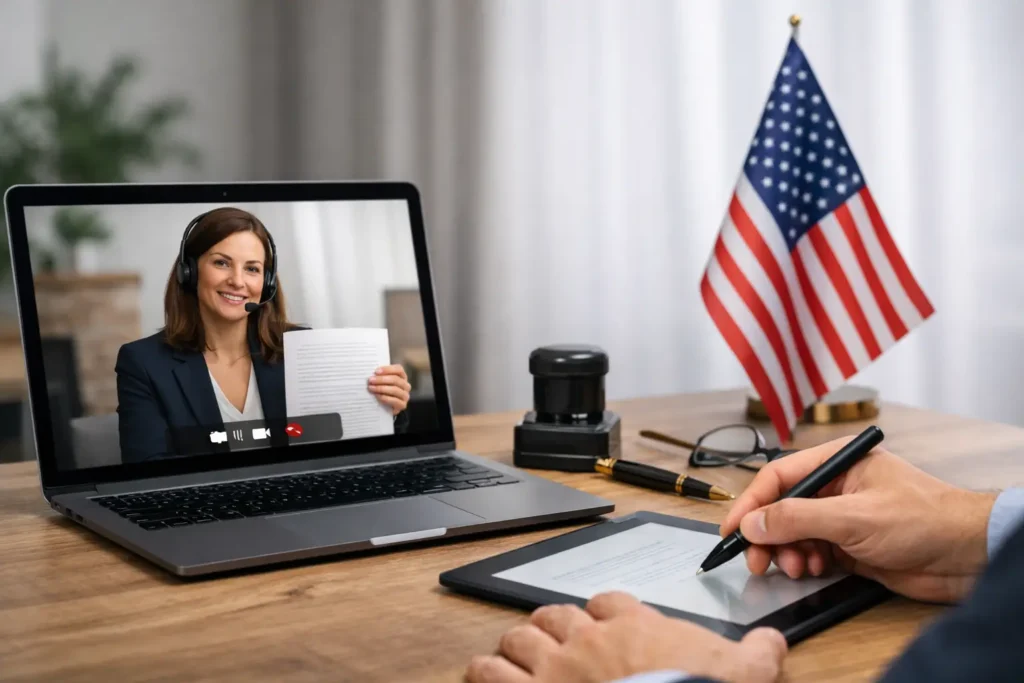
Remote online notarization, often called RON, is a notarization performed over approved audio-video technology rather than face to face in the same room. The notary still follows legal procedures. The difference is that the appearance, identity checks, document signing, and notarial act happen online.
This is not the same as simply emailing a document to a notary or hopping on a casual video call. A lawful online notarization uses a platform and process designed for identity verification, electronic signatures, notarial certificates, and recordkeeping. The notary must be properly commissioned or authorized to perform remote online notarizations under the laws that apply to that notarization.
That distinction matters because customers often assume any scanned signature and Zoom meeting will do the job. It will not. If the notarization is not performed under the right rules, the receiving agency, lender, court, or title company may reject it.
Why people choose remote online notarization in the USA
The biggest reason is speed. When a deadline is measured in hours, driving to an office can feel like the slowest part of the process. Online notarization removes that trip and often makes same-day service far easier to arrange.
Convenience is close behind. If you are caring for a parent, recovering from surgery, traveling for work, stationed overseas, or trying to coordinate several signers in different places, online notarization can save a lot of friction. Business clients also benefit because recurring paperwork can be completed without pulling staff away from operations.
There is also a reliability factor. Digital platforms create a cleaner signing process for many documents because they guide the signer through each required step. That can reduce missed signatures, skipped initials, and incomplete notarial certificates. Of course, it does not remove every issue. If the document itself is wrong, if the signer lacks valid ID, or if the receiving party does not accept online notarization, the technology will not fix that.
How the process works
Most remote online notarization USA appointments follow a clear sequence. First, the signer uploads or receives the document in the online system. Then the platform and notary verify identity using approved methods, which may include credential analysis and knowledge-based authentication, depending on the jurisdiction and the platform.
After that, the signer and notary meet by live audio-video session. The notary confirms the signer’s willingness, awareness, and identity, reviews the document as needed for the notarial act, and watches the signer apply the electronic signature. The notary then completes the electronic notarial certificate and seal.
Once finished, the signer usually receives the completed digital document promptly. Some transactions move forward immediately from there. Others still require review by a lender, title company, law office, or agency before the next step happens.
Who can use it and when it makes sense
Remote online notarization can be a strong fit for individuals, families, and businesses. It works well for power of attorney forms, affidavits, certain real estate documents, permission forms, business records, and many other documents that can legally be notarized online and are accepted by the requesting party.
It is especially useful when mobility, distance, or time is the real problem. A signer in Reno may need a document notarized after work. A family member in Carson City may need urgent paperwork handled without arranging transportation. A business user may need repeat notarizations across multiple offices without sending staff to a storefront every time.
That said, not every document is a good candidate. Some documents are governed by state-specific rules, county recording practices, lender overlays, or agency policies. Some recipients accept online notarization easily. Others still insist on paper originals or in-person signing. If the document is time-sensitive, it is smart to confirm acceptance before the appointment starts.
The legal side of remote online notarization USA
This is where customers can get confused, because the answer is not one-size-fits-all. Remote online notarization is legal in much of the country, but laws, authorization rules, and acceptance standards can vary by state and by document type.
The notary’s commissioning state usually plays a major role in the rules that govern the notarization. At the same time, the document may be used in another state, by a federal agency, or by a private institution with its own acceptance requirements. In practical terms, that means a notarization may be validly performed online but still create problems if the receiving party has a policy against it.
This is why professional screening matters. A fast appointment is helpful only if the completed notarization is usable for your actual purpose. For urgent signers, the best approach is simple: identify the document, verify who will receive it, and confirm whether an online notarization will work before you proceed.
What you need before your appointment
Most online notarization appointments go smoothly when the signer is prepared. You typically need a stable internet connection, a device with a camera and microphone, a valid government-issued photo ID, and the document ready for review or upload.
You also need to be willing and able to sign. If a person lacks awareness of what they are signing, is under pressure, or cannot communicate adequately with the notary, the notarization should not go forward. That rule applies in person and online alike.
A quiet setting helps more than people expect. If your audio cuts out, your lighting is poor, or other people keep interrupting the session, the appointment can slow down or fail. When the document is urgent, those small details matter.
When mobile notarization may still be the better choice
Online service is efficient, but it is not automatically the best fit every time. Some signers are not comfortable with technology. Some have identification that does not pass digital checks. Some transactions still require wet signatures, witnesses in the room, or original paper handling.
That is where a dual-service provider has a real advantage. If an online appointment is not the right path, mobile notary service can often solve the problem quickly by bringing the notary to the signer instead of sending the signer hunting for an office. For hospitals, care facilities, law offices, and last-minute family paperwork, that flexibility can save a deal or calm a stressful situation.
This is one reason many Nevada customers prefer working with a service that can handle both options. If remote online notarization works, great. If the document or signer needs an in-person visit, there is still a fast path forward.
Common mistakes that cause delays
Most problems come from avoidable issues. The signer uploads the wrong document version. The name on the document does not match the ID. The receiving party was never asked whether online notarization is acceptable. A witness is required, but nobody arranged for one.
Another common issue is assuming all documents can be handled the same way. They cannot. Real estate packages, healthcare documents, court-related paperwork, and business records each come with their own practical concerns. The fastest way to complete notarization is to identify those concerns early rather than discovering them halfway through the appointment.
If speed matters, communicate clearly from the start. Say what the document is, when you need it done, where it will be submitted, and whether anyone else must sign. That makes it easier to confirm the right service and avoid rework.
For customers who need responsive help with urgent paperwork, Mobile Notary Nation focuses on that exact problem – getting the notarization done quickly, correctly, and in the format that fits the document and the deadline.
Remote online notarization is not just a convenience feature. For many people, it is the difference between meeting a deadline and missing one. If your document can be notarized online and the receiving party will accept it, the fastest move is often the simplest one: get it handled now, while the window is still open.