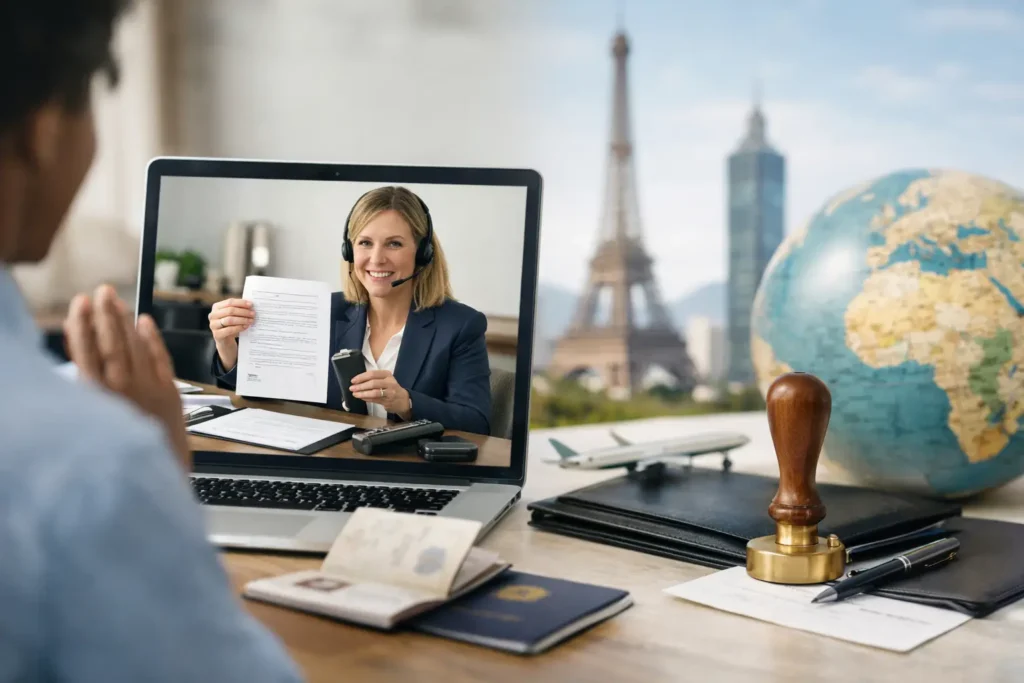
A document deadline does not pause because you are stationed overseas, studying abroad, traveling for work, or helping a family member from another country. Remote notarization for an overseas client can be a practical answer when an in-person U.S. notary is out of reach, but eligibility and document acceptance must be confirmed before the appointment starts.
For eligible U.S. citizens and permanent residents abroad, a remote online notarization may allow the signer to appear by secure live video, verify identity, sign electronically, and receive a completed electronic notarization without visiting a consulate or mailing original paperwork back and forth. The process can save critical time. Still, the receiving party has the final say on whether it will accept a remotely notarized document.
When Remote Notarization for Overseas Clients Works
Remote online notarization is generally most useful when the signer is physically outside the United States but needs a document notarized under U.S. requirements. Common examples include powers of attorney, affidavits, business forms, lender paperwork, certain real estate documents, consent forms, and documents needed by a U.S.-based attorney, bank, employer, or agency.
The key distinction is that the document usually needs to be accepted by a U.S. recipient. A Nevada online notary may perform a remote notarization for an eligible person located abroad, provided the session meets applicable state requirements and the signer can complete identity verification through the approved online platform.
That does not mean every overseas document is a fit. If the document will be filed with a foreign government, used in a foreign court, or delivered to an institution outside the United States, that organization may require a local notary, a U.S. consular service, an apostille, legalization, wet ink signatures, or a different form of certification. A remote notarization and an apostille are not the same service. Confirm the document recipient’s requirements before scheduling.
Start With Acceptance, Not the Appointment
The fastest way to avoid a failed signing is to ask the recipient one direct question: “Will you accept a U.S. remote online notarization completed by live audio-video technology?” Ask it before you pay fees, arrange witnesses, or sign anything.
This matters most for deeds, estate planning documents, lender packages, international business filings, and documents with witness requirements. Some recipients accept electronic notarizations readily. Others still require original paper documents or have their own signing instructions. The answer can depend on the type of document, the state governing the transaction, and the recipient’s internal policies.
If the recipient says an electronic notarization is acceptable, ask whether witnesses are required and whether they must be physically with the signer. Do not assume that a family member, colleague, or friend can serve as a witness. Witness rules vary by document and jurisdiction, and interested parties may not qualify.
What an Overseas Signer Needs
A remote session is quick when the signer has the right materials ready. The notary cannot simply rely on a photo of an ID over a video call. Remote online notarization uses layered identity verification designed to establish that the person on screen is the person named in the document.
Before the appointment, the signer should have a current, unexpired government-issued photo ID accepted by the platform. A U.S. driver’s license, state ID, or passport is often used, depending on the identity verification process. The signer may also need a U.S. Social Security number for knowledge-based authentication questions and a device capable of receiving a one-time passcode.
Reliable internet, a camera, and a microphone are equally important. A laptop or desktop computer is usually the easiest option because it provides a larger screen for reviewing and signing documents, although a compatible smartphone or tablet may work. The signer should choose a quiet, well-lit location with a stable connection. Poor lighting, a weak signal, and background noise can delay identity verification or make the video record unusable.
Have the complete unsigned document ready in its final form. Do not sign it in advance unless the receiving party has specifically instructed you to do so. During a remote notarization, the notary must witness the electronic signing or administer an oath or acknowledgment as required. Blank spaces should be addressed before the session begins, except for fields that are intentionally left blank under the recipient’s instructions.
How the Remote Notarization Process Usually Goes
The session begins with an invitation to a secure online notarization platform. The signer follows the prompts to upload identification, answer identity verification questions when required, and join a live audio-video meeting with the commissioned online notary.
The notary will confirm the signer’s identity, willingness to sign, and awareness of the document. For a jurat or sworn statement, the signer will take an oath or affirmation. For an acknowledgment, the signer confirms that they signed voluntarily for the stated purpose. These are different notarial acts, so the document instructions matter.
Once the required act is completed, the signer applies an electronic signature while the notary is present online. The notary then applies the electronic notarial certificate and tamper-evident seal. The completed file is typically available electronically after the session, allowing the signer to send it to the intended recipient right away.
A legitimate remote online notarization includes more than a video chat. It creates a secure electronic record, and the session is recorded as required by law. That record helps protect the signer, the recipient, and the notary if the notarization is questioned later.
Common Delays and How to Prevent Them
Most delays are preventable. An expired ID, a name mismatch between the ID and document, incomplete pages, an unstable internet connection, or a signer who cannot pass identity verification can stop the process. The best solution is to review the document and identification before the appointment rather than trying to solve these issues during a deadline-driven session.
Name differences deserve special attention. If the document shows a maiden name, middle initial, suffix, or alternate spelling that does not match the ID, ask the receiving party or document preparer how it should be handled. A notary cannot advise you on how to change legal document language or select the correct notarial certificate.
Time zones also matter. A signer in Europe, Asia, or the Middle East may be working during Northern Nevada’s evening hours. Schedule early enough to allow for platform verification, witness coordination, and corrections if the recipient rejects a file for administrative reasons. Same-day service can be helpful, but a deadline is easier to protect when there is room for a second attempt.
When a Mobile Notary or Consulate May Be Better
Remote notarization is not automatically the best option. If the recipient requires an original ink-signed document, if the document needs physical witnesses, or if the signer cannot meet online identity verification requirements, another route may be necessary. A U.S. embassy or consulate may offer notarial services, though appointments and availability can be limited. A local foreign notary may also be appropriate when the document will be used under that country’s rules.
For signers located in Reno, Sparks, Carson City, or nearby Northern Nevada communities, an in-person mobile appointment may be the simpler choice for paper documents or urgent witness logistics. Mobile Notary Nation can help determine whether a mobile appointment or a remote online session better matches the document’s requirements.
Book With the Right Details Ready
When requesting a remote appointment from abroad, provide the document type, the country where the signer is located, the deadline, whether witnesses are needed, and the name of the receiving organization. This allows the notary service to identify obvious timing or eligibility issues before the session is scheduled.
Do not wait until the last hour to learn that a bank wants wet ink or that a foreign agency needs an apostille. A short confirmation with the document recipient can turn a stressful overseas signing into a completed, usable document on the same day. When the paperwork matters, the right question is not simply whether you can notarize online, but whether the notarization will work where the document needs to go.