A document is ready, the deadline is close, and the real question is not whether you need a notary – it is whether online notary vs in person service will get the job done faster and with fewer problems. The right choice depends on your document, your location, your signer requirements, and how much flexibility you need.
For some people, remote online notarization is the fastest path from unsigned paperwork to completed filing. For others, an in-person appointment is the only practical option, especially when the signer is not comfortable with technology, the document package is large, or the receiving party insists on wet signatures. If you are trying to decide quickly, it helps to look at how each option works in the real world, not just on paper.
Online notary vs in person: the core difference
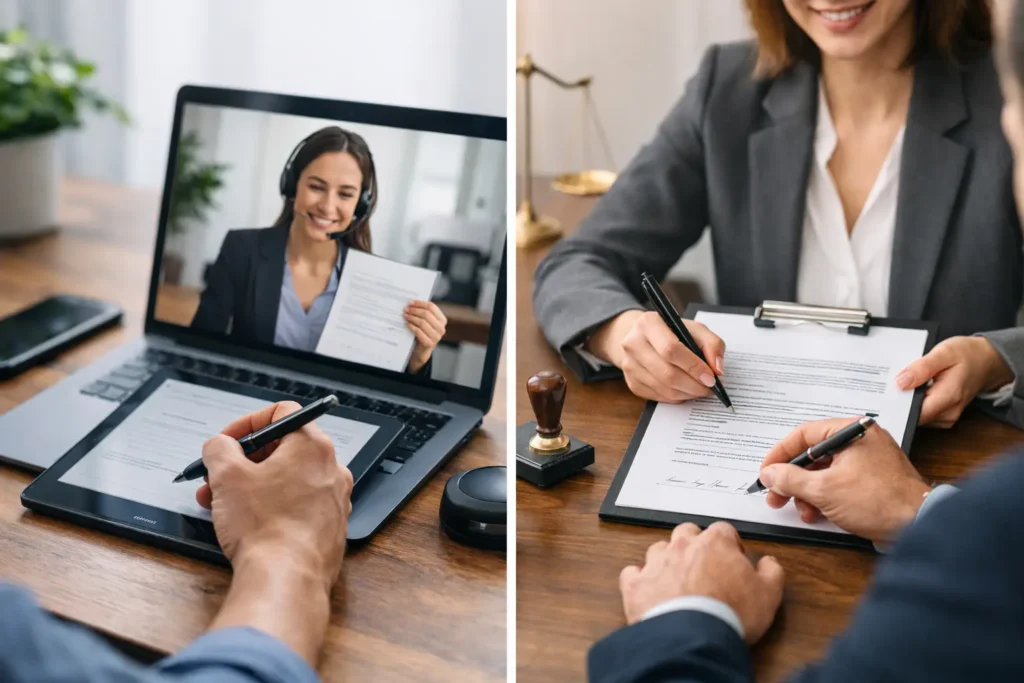
An online notarization happens through a secure audio-video session. The signer verifies identity digitally, signs electronically, and the notary completes the act remotely if the document and jurisdiction allow it. This option removes travel, office visits, and a lot of scheduling friction.
An in-person notarization happens with the signer and notary physically together. That may be at a home, office, hospital, jail, title company, care facility, or another agreed location. Identity is checked face to face, and the signer usually signs the paper document in front of the notary.
The legal purpose is the same in both cases. The difference is in logistics, document handling, and what the receiving agency, lender, court, or institution will accept.
When online notarization is the better fit
If speed and convenience are your top priorities, online service often wins. A signer can complete the appointment from home, a hotel room, an office, or even while traveling, as long as they have the right ID, a reliable internet connection, and a device with a camera and microphone.
This is especially useful when the signer is outside Nevada, working odd hours, or trying to avoid delays caused by traffic, transportation, weather, or office availability. For business users, online appointments can also reduce interruptions. A manager, client, or team member can join a scheduled session without coordinating a physical meetup.
Online notarization also helps in situations where time zones or distance would otherwise slow everything down. A U.S. citizen or permanent resident abroad may be able to complete an eligible notarization remotely instead of trying to locate a nearby consulate or a local notarial service that does not meet U.S. requirements.
That said, online service is only better when the document is eligible and the signer can complete the identity verification process. If either of those fails, the convenience disappears quickly.
Online notarization works best when:
The signer is comfortable using a computer or smartphone, the document can be signed electronically, and the receiving party accepts remote notarization. It is also a strong option when the appointment needs to happen fast and travel would be the main obstacle.
When in-person notarization makes more sense
In-person service is often the safer choice when there is any doubt about document acceptance. Some institutions still prefer or require original paper documents with ink signatures. Certain document types, agencies, or transaction partners may have their own rules, even when remote notarization is legal more broadly.
It is also better for signers who need more support during the appointment. Elderly clients, hospitalized patients, people in assisted living, and individuals with limited comfort using technology are often easier to serve face to face. The same is true when a signer does not have the right device, struggles with ID verification questions, or has unreliable internet.
Large document packages can also be easier in person. Real estate paperwork, estate planning sets, and business packets sometimes involve multiple signers, witnesses, attachments, and detailed signature instructions. A mobile notary can help keep the appointment organized and reduce the chance of missed signatures.
For urgent local needs in Reno, Sparks, Carson City, and nearby areas, mobile in-person service can be the fastest answer when online is not an option. Instead of waiting for office hours or driving across town, the notary comes to you.
The biggest deciding factor: document acceptance
This is where many people get stuck. They assume that if online notarization is legal, every recipient must accept it. That is not always how it plays out.
Before choosing between online notary vs in person service, ask who will receive the document and what they require. A county recorder, lender, court, employer, title company, or government office may have its own standards. Some will accept electronically notarized documents without hesitation. Others may want originals, wet signatures, or documents notarized in a specific format.
If you are handling a power of attorney, deed, affidavit, loan package, healthcare directive, or estate planning document, it is worth confirming the recipient’s rules first. A fast appointment is only helpful if the completed document will actually be accepted.
ID verification and signer readiness
Online notarization usually involves credential analysis and identity verification. That can include uploading ID images and answering knowledge-based questions. For many signers, this is simple. For others, it becomes the obstacle that stops the appointment.
A person with thin credit history, recent address changes, limited digital experience, or an older form of identification may have trouble passing the platform’s verification steps. If that happens, in-person notarization may be more practical.
Face-to-face notarization is often more forgiving from a user-experience standpoint because the notary can inspect acceptable ID directly. It is still critical to have proper identification and document readiness, but the process feels more straightforward for many clients.
Speed is not always what people expect
Most people assume online means faster every time. Sometimes it does. Sometimes it does not.
If your document is eligible, your ID is current, your internet is stable, and the receiving party accepts remote notarization, online can be extremely efficient. You avoid travel, waiting rooms, and office scheduling. That is a real advantage when the matter is time-sensitive.
But if the signer has trouble uploading ID, cannot pass verification, or needs to print and ship originals afterward anyway, online may add steps instead of removing them. In-person service can actually be faster when the notary travels to your home, office, hospital, or job site and completes the appointment in one visit.
This is why the best choice is usually the one with the fewest points of failure, not just the one that sounds more modern.
Cost, convenience, and practical trade-offs
Online appointments often reduce travel-related inconvenience. That can make them feel more efficient, especially for single-document signings or out-of-area signers. They are also easier to schedule across broader geographic distances.
In-person mobile service adds the benefit of direct support. The notary comes to the signer, which is valuable when the client cannot leave work, is caring for a family member, is admitted to a facility, or needs multiple people notarized at one location. For many customers, that convenience justifies the added travel component.
The real comparison is not just price. It is whether the appointment gets completed correctly, on time, and in the format the recipient needs. A cheaper option that creates a rejection or delay can cost more in the end.
How to choose the right option quickly
Start with three questions. First, will the receiving party accept remote notarization? Second, can the signer complete an online ID verification and video session without trouble? Third, does the document need original paper signatures or special handling?
If the answer to the first two is yes, online may be the fastest route. If the answer to either is no, in-person is often the better call. If you are still unsure, the safest move is to ask before the appointment is booked so you do not lose time.
At Mobile Notary Nation, that practical approach matters because most customers are not comparing formats for fun. They are trying to solve a deadline, close a transaction, admit a patient, finalize a legal matter, or keep business moving.
Which option is better?
Neither option is better in every case. Online notarization is excellent when you need flexibility, distance is a factor, and the document is approved for remote handling. In-person notarization is stronger when acceptance rules are stricter, the signer needs hands-on support, or the paperwork is better handled on paper.
The smartest choice is the one that matches your document requirements and your timeline without adding unnecessary risk. If you are under pressure, that clarity matters more than anything else.
When the paperwork is urgent, do not guess. Confirm what the document requires, choose the format that fits, and get the signing handled while there is still time.