
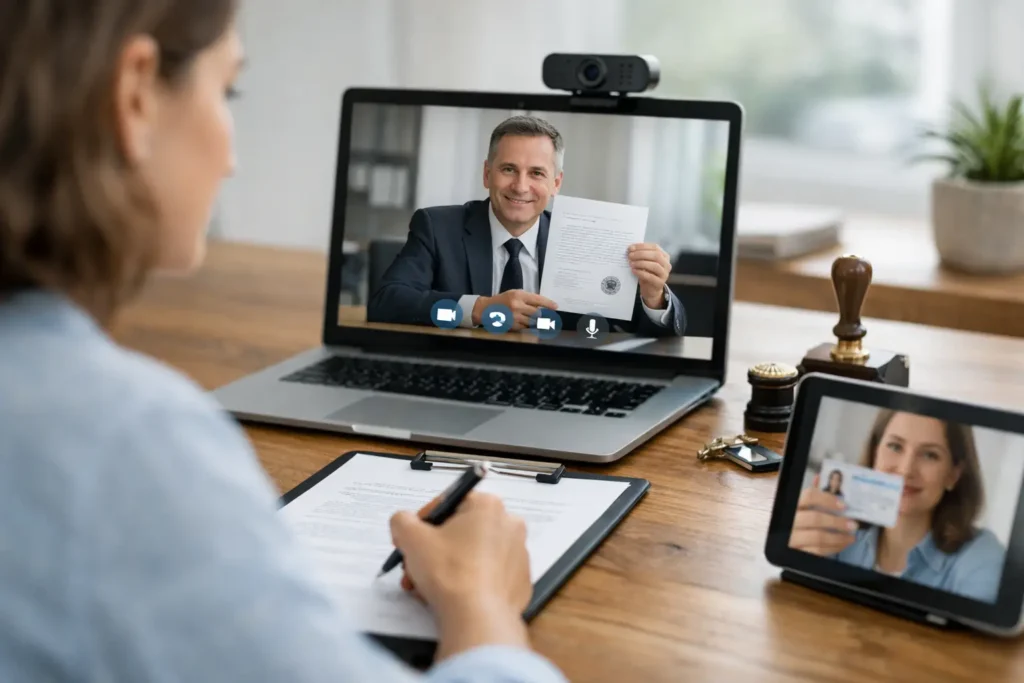
A document is ready, the deadline is close, and getting to a notary in person is the hard part. That is usually when people start asking how remote notarization works and whether it is legally valid for what they need. The short answer is that remote notarization lets you meet with a commissioned notary online, verify your identity, sign electronically, and complete the notarization by live audio-video session.
For many people, that means no driving across town, no waiting room, and no rearranging a workday just to get a signature notarized. For businesses, it often means fewer delays in document workflows. But remote notarization is not a one-size-fits-all service. The details matter, especially when a lender, court, title company, or receiving agency has its own rules.
How remote notarization works step by step
At its core, remote online notarization follows the same purpose as a traditional notarization. The notary is there to confirm identity, witness the signing when required, and complete the notarial act according to state law. The difference is that the meeting happens through a secure online platform rather than across a desk.
The process usually starts when you upload your document or send it in advance for review. This gives the notary a chance to confirm whether the document appears suitable for remote notarization and whether any blanks or obvious issues need to be fixed before the appointment. If witnesses are required, that should be addressed before the session starts, not halfway through it.
Next comes identity verification. In most remote notarization sessions, you will be asked to present a valid government-issued photo ID. Depending on the platform and the governing state rules, you may also go through credential analysis and knowledge-based authentication. That means the system checks the ID for authenticity and may ask personal history questions that only you should be able to answer.
Once your identity is verified, the notary connects with you by live audio-video. This is not a recorded message or a simple document upload. It is a real-time session where the notary can see you, hear you, and assess whether you appear willing, aware, and competent to sign. If the notary has concerns about coercion, confusion, or missing information, the appointment can be paused or stopped.
After that, you sign electronically where directed. The notary then completes the notarial certificate and applies an electronic seal and signature. The platform typically generates a tamper-evident final document. A recording of the session may also be retained as required by law.
What makes remote notarization legally different
People often assume online notarization is just e-signing with a witness. It is more than that. A standard e-signature process may let you sign a document digitally, but notarization adds a regulated identity check and a commissioned official who performs a legal act.
That is why the rules are not identical everywhere. Remote notarization is governed by state law, and the notary must follow the rules of the state where the notary is commissioned. At the same time, the receiving party must accept a remotely notarized document. In practice, that means a document may be properly notarized online and still need advance confirmation from the bank, recorder, court, or agency that will receive it.
This is where delays happen. The issue is often not whether remote notarization exists. The issue is whether your specific document, your timing, and the receiving institution all line up. If you are handling real estate, estate planning, powers of attorney, healthcare forms, or out-of-state filings, it is smart to check acceptance before the appointment.
What you need before your appointment
A smooth session depends on basic preparation. Most failed or delayed remote notarizations happen because of missing ID, poor internet, incomplete documents, or signer confusion about what is required.
You generally need a current government-issued photo ID, a device with a camera and microphone, a stable internet connection, and your unsigned document unless you are specifically told to sign certain parts in advance. You should also be in a quiet place where the notary can clearly communicate with you and confirm that you are signing voluntarily.
If your document needs witnesses, ask about that ahead of time. Some platforms can provide witnesses in certain situations, and some cannot. If the document has multiple signers, each signer may need separate identity verification and may need to appear during the live session.
For signers overseas, eligibility can depend on the document, the platform, and the governing legal requirements. A U.S. citizen or permanent resident abroad may be able to complete remote notarization in many cases, but the receiving institution still has the final say on acceptance.
Which documents can and cannot be notarized remotely
Many common documents can be notarized remotely, including affidavits, acknowledgments, sworn statements, certain real estate documents, powers of attorney, and business forms. That said, document type alone does not settle the question.
Some documents are restricted by state law. Others are technically allowed but not accepted by a county recorder, foreign jurisdiction, or private institution. Wet-ink original requirements can also create problems. If a receiving party insists on a physical original with pen-and-ink signatures, remote notarization may not be the right fit.
This is especially relevant for estate documents and real property filings. In some cases, remote notarization works well and saves significant time. In other cases, an in-person mobile notary is the better choice because the title company, recorder, or attorney wants traditional paper execution. That is why a dual-service provider can be useful. If online is not the right lane, there should be a fast backup plan.
Common reasons a remote notarization gets delayed
The biggest issue is identity verification failure. Sometimes the ID is expired, damaged, or difficult for the software to scan. Sometimes the knowledge-based questions pull from records that do not match the signer’s current information. This happens more often than people expect, especially after recent moves or name changes.
Technology problems are next. Weak audio, unstable video, blocked camera permissions, and last-minute device issues can stop an otherwise simple appointment. A smartphone, tablet, or laptop usually works well, but only if the browser, camera, and microphone are cooperating.
The third common problem is document readiness. Blank spaces, mismatched names, missing witness requirements, or uncertainty about what notarial act is needed can all slow things down. A notary can identify issues, but cannot give legal advice about how to draft the document or choose the wrong certificate for you.
If timing matters, it helps to send the document for review first and confirm any special requirements before the session. That is often the difference between a 15-minute appointment and a missed deadline.
How remote notarization works for urgent situations
Urgent cases are where remote notarization often makes the most sense. If someone is traveling, homebound, working late, managing a closing deadline, or trying to complete documents from another state, online access can remove the biggest bottleneck.
It is also useful for businesses that need recurring notarizations without sending staff offsite. Law offices, lenders, healthcare organizations, and administrative teams often care less about the novelty of online notarization and more about speed, documentation, and predictable turnaround. If the process is set up correctly, remote notarization can reduce wasted time and keep files moving.
Still, urgency does not override compliance. If the platform cannot verify identity, if the document is not approved for remote handling, or if the receiving party refuses online notarization, forcing the issue usually creates a bigger mess. Fast service only helps when it is the right service.
How to know whether remote notarization is the right choice
If your priority is convenience, speed, and flexibility, remote notarization is often a strong option. It works well when the document can be signed electronically, the receiving party accepts online notarization, and the signer has valid ID and decent technology.
If your situation involves paper-only originals, special witness logistics, hesitant recipients, or signers who are not comfortable with technology, in-person service may be better. That is not a failure of the online process. It just means the practical answer depends on the document and the deadline.
For clients in Northern Nevada who need something handled quickly, that choice often comes down to a simple question: can this be completed online without creating a problem later? Mobile Notary Nation approaches it that way because speed matters, but getting it done correctly matters more.
When you are under pressure, the best notarization option is the one that clears the requirement the first time. A quick call to confirm the document, signing setup, and acceptance rules can save hours you do not have.