A missed notary requirement can hold up a real estate closing, delay a healthcare form, or send you back for a second appointment. The key issue in the jurat vs acknowledgment notary question is not which certificate is “better.” It is which notarial act your document requires. They serve different purposes, involve different statements from the signer, and can affect when you need to sign.
If you need a document notarized quickly, taking 30 seconds to identify the certificate wording can save a great deal of time. A notary can verify identity and complete the requested notarial act, but cannot choose the certificate for you or tell you what your document needs from a legal standpoint.
Jurat vs Acknowledgment Notary: The Core Difference
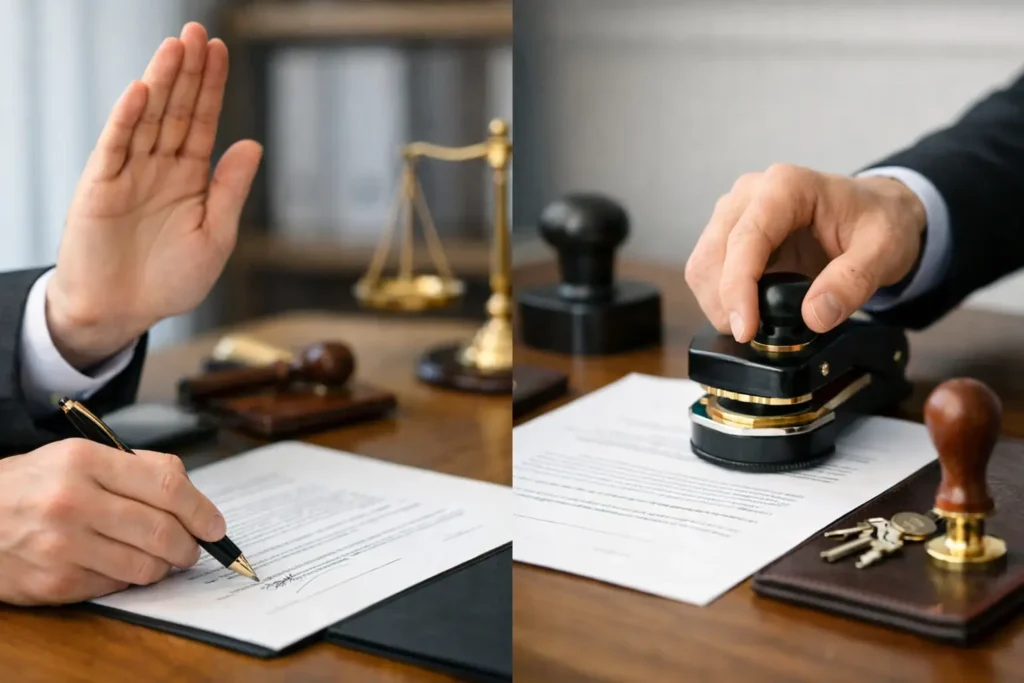
A jurat confirms that the signer personally appeared before the notary, signed the document in the notary’s presence, and took an oath or affirmation that the statements in the document are true.
An acknowledgment confirms that the signer personally appeared before the notary and declared that they signed the document willingly for its stated purpose. The signer is not swearing that every statement in the document is true.
That distinction matters. A jurat focuses on the truthfulness of the document’s statements. An acknowledgment focuses on the signer’s voluntary execution of the document.
Both acts require the notary to properly identify the signer and assess whether the signer appears aware and willing. Neither act means the notary has reviewed, approved, or verified the legal content of the document.
What Happens During a Jurat
A jurat is common when someone is making a sworn written statement. You may see it on an affidavit, declaration, sworn statement, verification, or certain court-related paperwork. The certificate language often includes words such as “subscribed and sworn to,” “affirmed,” or “under oath.”
For a jurat, the signer normally waits to sign until they are in front of the notary. The notary then administers an oath or affirmation. An oath is traditionally a solemn promise made to a higher power, while an affirmation is a solemn promise based on personal honor. Both carry the same legal weight.
The notary may ask a direct question such as: “Do you swear or affirm that the statements in this document are true and correct to the best of your knowledge and belief?” The signer must clearly answer yes or otherwise affirm the statement.
A jurat is not a casual formality. By taking the oath or affirmation, the signer is making a serious statement about the truthfulness of the document. If you are uncertain whether the contents are accurate, stop and resolve that issue before proceeding.
Timing is especially important
The most practical difference is often the signature timing. With a jurat, do not pre-sign unless the document provider or an attorney has given you specific instructions that comply with the applicable requirements. In a standard jurat appointment, the signer signs while the notary is present, then takes the oath or affirmation.
If a document has already been signed, the notary may need the signer to sign again in the proper place or may be unable to complete the requested jurat as presented. A quick review of the certificate before the appointment helps prevent this problem.
What Happens During an Acknowledgment
Acknowledgments are frequently used for deeds, powers of attorney, trust documents, business filings, and other documents where the central question is whether the signer executed the document voluntarily. The certificate may include language such as “acknowledged before me” or “personally appeared.”
Unlike a jurat, an acknowledgment does not require an oath or affirmation. The signer tells the notary that they signed the document willingly and understood the act of signing it.
The document may often be signed before the appointment. The signer still needs to personally appear before the notary and acknowledge the signature. Do not assume that a pre-signed document is always acceptable, however. The instructions from the receiving party, lender, attorney, agency, or document preparer should control.
For example, a homeowner signing a deed may sign in front of the notary or may acknowledge a signature already placed on the deed, depending on the document instructions and applicable rules. The notary’s job is to complete the acknowledgment certificate, not to decide whether a deed should be signed or whether the transaction terms are appropriate.
How to Tell Which Certificate Your Document Needs
Look at the notarial certificate, usually near the signature page or on an attached page. The wording often provides the answer. “Subscribed and sworn” points to a jurat. “Acknowledged before me” points to an acknowledgment.
Sometimes a document arrives with no certificate at all, or it includes more than one possible certificate. That is where people lose time. A notary cannot select a certificate based on what sounds right, because choosing one could be legal advice. Ask the organization receiving the document, the attorney handling the matter, the lender, court clerk, government agency, or document preparer which notarial act is required.
If you receive a clear answer, bring that instruction to the appointment. If the document is part of a time-sensitive transaction, ask before the notary arrives, not after everyone is gathered to sign.
Identity, Willingness, and Awareness Still Apply
Whether you need a jurat or an acknowledgment, expect the notary to check valid identification and confirm that you appear willing and aware of what you are signing. A rushed appointment does not remove these safeguards.
The signer must be present for an in-person notarization. For eligible remote online notarizations, the signer appears through approved audio-video technology and completes the identity verification and electronic signing process required for that transaction. A scanned ID or a family member’s assurance is not a substitute for the signer’s required appearance.
The notary may decline the notarization if identification is insufficient, the signer appears pressured or unable to understand the signing, the document is incomplete in a material way, or the requested certificate does not match the instructions provided. That is not an unnecessary delay. It protects the signer and the receiving party from a defective notarization.
Avoid a Second Appointment
Before booking, have these four items ready:
- The complete document, including any notarial certificate pages
- Unexpired, acceptable government-issued photo identification
- Clear instructions on whether the document needs a jurat or acknowledgment
- Every signer who must personally appear, with enough time to review and sign
Do not fill in the notary’s certificate section yourself unless the document provider has instructed you to do so. Also, do not leave required signer information blank or remove certificate pages because they look separate from the main document. The receiving party may reject a document that is technically notarized but incomplete.
For a jurat, plan to sign during the appointment and be ready to take an oath or affirmation. For an acknowledgment, be prepared to confirm that you signed willingly. These small preparations make a same-day appointment much more likely to stay on schedule.
When Speed Matters, Confirm Before the Notary Arrives
Urgent documents are often the ones with the highest stakes: closing packages, medical directives, estate documents, business authorizations, or affidavits needed for a pending matter. A mobile notary can come to your home, office, hospital, or another agreed location, but mobility does not replace preparation.
If you are in Reno, Sparks, Carson City, or nearby Northern Nevada communities, Mobile Notary Nation can help coordinate a prompt mobile or remote online notarization when eligible. Have the document and certificate requirement ready when you call so the appointment can be matched to what you actually need.
The best next step is simple: read the certificate wording, confirm any uncertainty with the document recipient, and keep your ID and all signers ready. That one check can turn a last-minute notarization into a completed document instead of another deadline problem.