
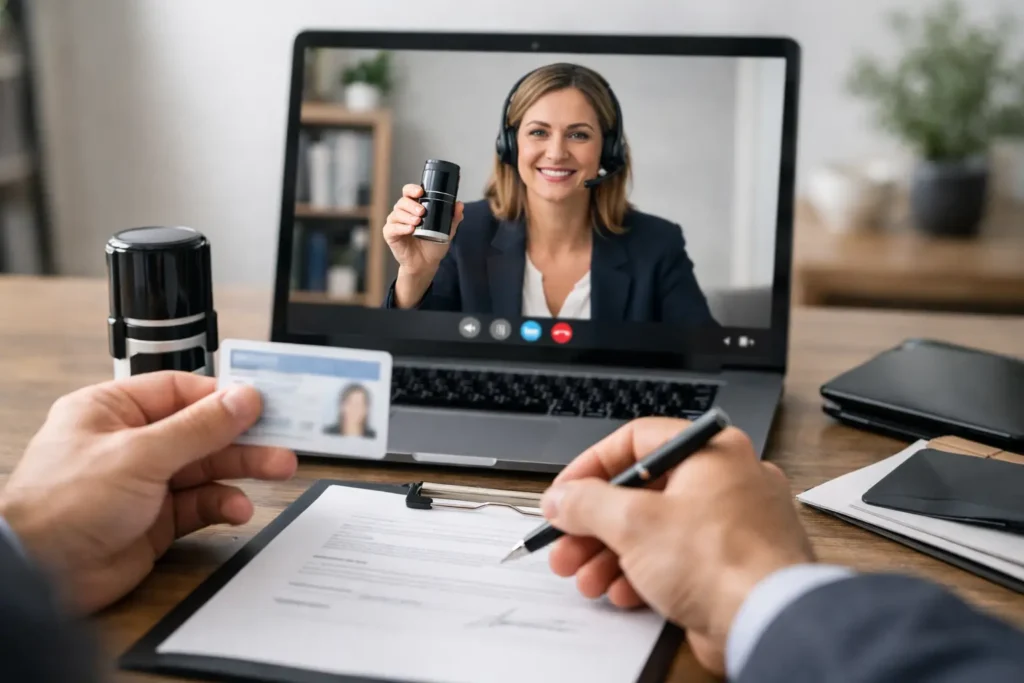
When a document has to be notarized today, driving across town, waiting in an office, and working around business hours is usually the last thing you want to do. That is exactly why people ask, how does remote notarization work, and whether it can handle real deadlines without cutting corners. In many cases, it can.
Remote notarization lets you meet with a commissioned online notary through a secure audio-video platform instead of sitting across a desk in person. You and the notary appear live on camera, your identity is verified, you sign electronically, and the notary completes the notarization digitally. The process is designed to be fast, but it still follows specific legal and procedural steps.
How does remote notarization work step by step?
The easiest way to understand remote notarization is to think of it as a live notary appointment moved online, with extra identity checks built in.
First, you upload the document that needs notarization. Some platforms let you drag and drop a PDF, while others guide you through adding signature and notary fields before the session starts. If the document is incomplete, that usually needs to be fixed before the appointment. A notary can notarize a signature, but cannot decide how you should fill out your form.
Next comes identity verification. This is one of the biggest differences between remote online notarization and a traditional in-person appointment. Instead of showing a physical ID across a table, you typically upload or scan your government-issued identification and answer authentication questions tied to your personal history. The platform may also use credential analysis to confirm the ID appears valid.
After that, you join a live video call with the notary. This part matters. Remote notarization is not the same as emailing a signed document and asking someone to stamp it later. The signer must appear before the notary in real time through approved audio-video technology. The notary watches you, confirms you appear willing and aware, and may ask a few direct questions before moving forward.
Once your identity and readiness are confirmed, you sign electronically during the session. The notary then applies the electronic notarial certificate and digital seal. In many cases, the completed file is tamper-evident, which helps show if any changes were made after notarization. You usually receive the finalized document shortly after the session ends.
What the notary is actually verifying
People sometimes assume notarization means the notary is approving the contents of a document. That is not the job. Whether the appointment happens online or in person, the notary is mainly verifying the signer.
The notary is checking that you are the person you claim to be, that you appear to understand what you are signing, and that you are signing willingly. If the document requires an oath or affirmation, the notary administers that during the video session. If the signer seems confused, pressured, impaired, or unable to communicate clearly, the notarization may need to stop.
That is one reason remote notarization can be convenient without being casual. The process is quicker for many people, but the standards are still there.
What you need before your appointment
A smooth remote notarization appointment usually depends on preparation more than anything else. The technology is not complicated, but a few basics have to be in place.
You need a reliable internet connection, a device with a camera and microphone, and a valid government-issued photo ID. You also need the document ready in the correct format, usually as a PDF. Your name on the document should match your identification closely enough to avoid unnecessary delays.
You should also be in a quiet place where you can be seen and heard clearly. If the connection keeps freezing or the notary cannot verify your identity on camera, the session may have to be paused or rescheduled. For urgent signings, that is avoidable if you test your setup first.
Some documents also require witnesses. In remote notarization, witness rules can vary depending on the document type and the laws that apply. Sometimes the platform can provide witnesses, and sometimes you need to arrange them yourself. This is one of those areas where it depends on the situation, so it is worth confirming before your appointment begins.
Is remote notarization legal?
Yes, remote notarization is legal in many cases, but the practical answer is a little more specific than that.
Remote online notarization is governed by state law, and not every state handles it the same way. A notary must be properly authorized to perform remote notarizations under the laws of the state where the notary is commissioned. At the same time, the document itself must be acceptable for remote notarization, and the receiving party must be willing to accept it.
That last part matters more than people expect. A document may be legally notarized online, but a county office, lender, court, or private institution may have its own acceptance standards. Real estate documents, estate planning papers, power of attorney forms, and business documents can all have different requirements depending on where they are going.
If you are working against a deadline, the smart move is to confirm acceptance before the appointment, not after. That can save you from having to redo the notarization in another format.
When remote notarization is the fastest option
Remote notarization is especially useful when the issue is time, distance, mobility, or all three.
If you are traveling, working late, caring for a family member, or trying to close a transaction without leaving your office, an online appointment can remove hours of friction. It also helps when signers are in different locations. Instead of coordinating everyone in one physical room, the notarization can happen through a secure virtual session.
For customers in Northern Nevada, this can be a practical alternative when traffic, weather, work schedules, or health concerns make an in-person stop unrealistic. It is also useful for business clients who need repeatable document workflows and do not want every urgent notarization to turn into a scheduling problem.
That said, remote notarization is not always the best answer. If the signer is not comfortable with technology, lacks valid ID, has poor internet access, or needs a document type that is better handled in person, a mobile notary appointment may be the better route. Speed is important, but only if the notarization is done correctly and accepted where it needs to go.
Common reasons a remote notarization gets delayed
Most problems come down to one of three things: the wrong document setup, identity verification issues, or technical trouble.
A missing notarial certificate can slow things down. So can a document that is partly filled out in a way that creates confusion about what is being signed. Identity problems are another common issue. An expired ID, blurry camera image, or failed knowledge-based authentication can stop the process before it starts.
Then there is the technology itself. If your browser is outdated, your microphone is blocked, or your internet connection is unstable, the notary may not be able to complete the session. None of these problems are unusual, but they are frustrating when you are under pressure.
The easiest fix is to prepare like you would for any important appointment. Have the right file, the right ID, a stable device, and a quiet place to sign.
Who remote notarization works well for
Remote notarization works well for both individual and business users, especially when convenience and timing matter. It can be a strong fit for people handling affidavits, consent forms, powers of attorney, contract documents, and many other common notarized records.
It is also useful for law firms, lenders, healthcare organizations, and administrative teams that need a dependable way to get documents completed without waiting on office traffic or travel time. For urgent cases, a responsive online notary can shorten the timeline significantly.
Mobile Notary Nation serves customers who often do not have the luxury of waiting until next week or even tomorrow. That is where remote online notarization can be more than a convenience. It can be the difference between meeting a deadline and missing one.
What to expect after the notarization
After the session is complete, you will usually receive the notarized electronic document promptly. Depending on the document, you may submit it electronically right away, or you may need to print it for the receiving party. If a wet-ink original is required, remote notarization may not be the right format in the first place.
Keep the final file exactly as delivered. Because remote notarized documents often include digital security features, altering the file after the fact can create problems with validity or acceptance.
If you are not sure whether your document can be notarized online, the best next step is simple: ask before you book, confirm what the receiving party requires, and choose the fastest valid option for your situation. When the process is set up correctly, remote notarization can be one of the quickest ways to get important paperwork signed and moving.